The price argument against the electric fleet just expired
August 24, 2026
In early May, we made a prediction. In The oil shock is forcing the electric future article, we argued that rising oil prices would accelerate fleet electrification, because electric driving in Switzerland already costs roughly 65% less per kilometre than petrol, and every fuel price spike widens that gap and shortens the payback. Oil prices, we wrote, set the pace more than the direction of the shift.
Since then, the new data has come in. And the pace has picked up, measurably. The one serious counterargument we couldn’t yet close in May – “electric cars still cost more to buy” – has now expired too.
First, the operating costs. Now, the purchase price.
Operating costs were always the strong half of the electric business case: cheaper energy, up to 50% lower maintenance, around CHF 190’000 in annual savings potential for a 100-vehicle fleet. The purchase price was the weak half. That was the number procurement pointed at when the decision stalled.
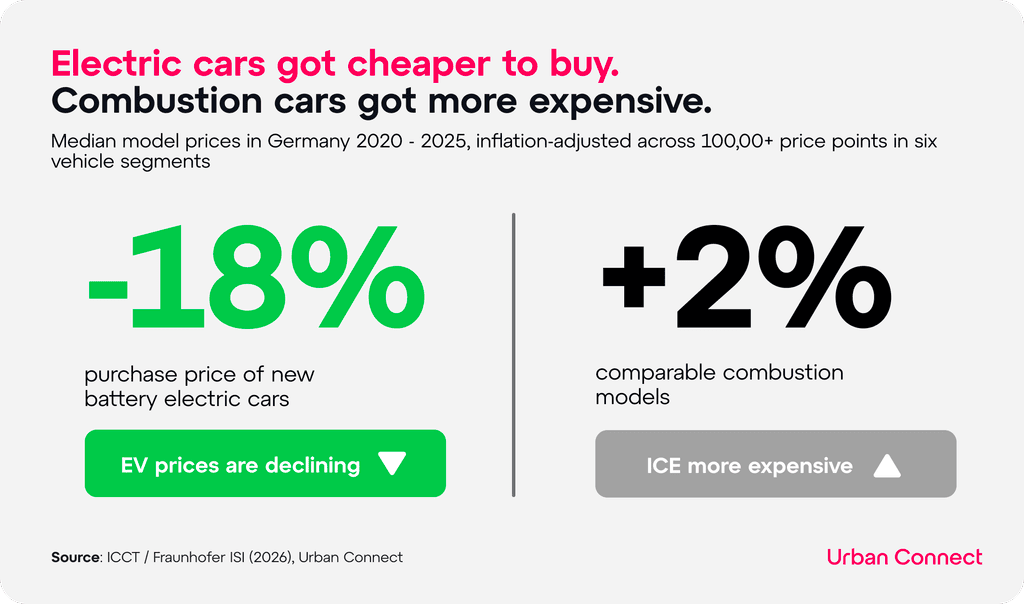
The context of new vehicle prices is changing now too. A study by the ICCT and Fraunhofer ISI, published on 20 July, tracked what actually happened to car prices in Germany between 2020 and 2025. They looked at more than 100,000 price points from the ADAC vehicle database, across six segments, adjusted for weight, motor output and range.
The result? Battery-electric vehicles became roughly 18% cheaper to buy in real, inflation-adjusted terms. Comparable combustion models became about 2% more expensive.
The driver of this trend is structural, not promotional. Battery pack costs fell from €165–185 per kWh to €130–140 between 2020 and 2025, a decline of around 36% once adjusted for inflation. That is the cost curve of the technology itself, not a discount cycle or a subsidy effect, pointing to likely further continuation of this trend. In addition to structurally lower battery costs, the number of EV models available has also increased, making more options available for consumers to buy. In Germany, for example, the number of available EV models more than quadrupled from 38 to 159 between 2020 and 2025, while the number of available combustion models even shrank by around 30%, from 275 to 194, over the same period. And across all these 159 EV models available in Germany, the average range has increased by over 30%. So, in short, EVs are becoming structurally more affordable, more plentiful in choice, and able to travel longer and longer distances on one charge.
Median model prices in Germany, 2020–2025, inflation-adjusted. Source: ICCT / Fraunhofer ISI (2026), Urban Connect
The Swiss registration data points the same way
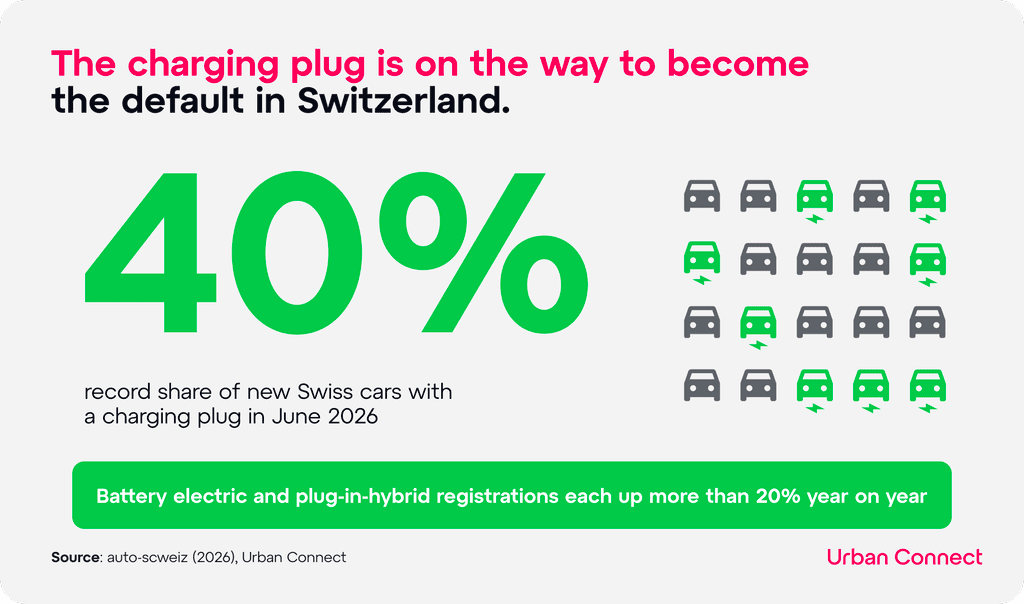
In Switzerland, the same shift is visible in the registration data. Electrification is gaining importance. Not overnight, but steadily. Across the first seven months of 2026, more than one in three new cars came with a charging plug (36.6%), and battery-electric alone accounted for roughly one in four (24.2%). June marked the high point so far: a record 40% of new registrations, the first time that threshold has ever been crossed (auto-schweiz). And this growth is not riding a general market boom, the overall market even shrank in July, while battery-electric and plug-in-hybrid registrations are each up more than 20% on last year. Diesel has lost almost a quarter, and combustion-only drivetrains keep shrinking.
Given the purchase-price shift described above and the structural trends behind it, there is good reason to expect this curve to steepen rather than flatten. The market seems to agree: announcing the July figures, the director of auto-schweiz attributed the growth to “a broad offering across all price and vehicle classes, sufficient ranges, and low operating costs”. When the importers’ association itself names operating costs as a growth driver, that is no longer our argument. The market itself is confirming the shift.
Plug-in share of new Swiss registrations, 2026. Source: auto-schweiz (2026), Urban Connect
The oil shock didn’t pass. It became structural.
When we published in May, you could still read the oil shock as one geopolitical event that could soon blow over. However, the TCS’s fuel-price analysis from mid-July suggests otherwise: petrol 95 averaged CHF 1.87 per litre in Switzerland, diesel CHF 2.05, up 3 and 5 Rappen in a single week. Behind the increase sit four stacked supply shocks, none resolving quickly: first, instability around the Strait of Hormuz; second, the attack-damaged refineries in the Gulf and Russia; third, temporary Chinese export curbs on refined fuels; and fourth and finally, the low water on the Rhine causing supply chain disruptions.
That last one adds a dimension our May analysis didn’t have. Low water on the Rhine roughly quadrupled freight costs in one month, from CHF 33.50 to CHF 143 per tonne, adding an estimated 8.5 Rappen per litre of petrol. So fuel costs are now exposed not only to geopolitics but also to climate volatility itself. That is no longer a bad month. That is a risk profile and the TCS expects further pressure if conditions persist.
Electricity tells the opposite story – one of stability. This is especially the case with workplace charging at contracted rates, which tend to be stable, plannable, and even negotiable at scale. And workplace charging is where fleet electricity actually happens. According to EnergieSchweiz and EBP, public charging covered only around 13% of Swiss EV energy in 2025. So roughly 87% is charged at home or at work, where the price per kilowatt-hour is contracted, and not quoted daily. For the majority of Swiss employees who rent and cannot charge at home, that workplace socket is becoming decisive. We covered the coming Right to Charge here.
What does this mean for Swiss fleet operators?
First: It pays to redo the TCO calculation
Any business case computed in 2023 or 2024 works with vehicle and fuel prices that are no longer current. Before the next procurement cycle, companies should therefore rerun the numbers with 2026 figures. The result may look quite different today.
Second: Fuel is now a budget risk, not just a cost item
A conventional fleet ties its running costs to geopolitical developments, supply chains and, increasingly, climate factors such as the water level of the Rhine. For CFOs, electrification is therefore becoming a question of predictability as much as of cost.
Third: Waiting has its price too
Every combustion vehicle bought today ties the company to exactly this volatility for three to eight years. At the same time, its resale market thins out as the model landscape keeps shifting towards electric.
Reading the data is easy. Acting on it is the hard part.
Rerunning the numbers takes an afternoon. Acting on them – choosing vehicles, building charging infrastructure, changing how a fleet is actually used – is where most companies stall. Understandably so, for it is not their core business. It is ours.
Urban Connect supports companies through exactly this transition. We assist with charging infrastructure and supply electric vehicles equipped with our state-of-the-art fleet sharing technology – one platform that handles booking, access and billing, tracks every vehicle, and shows how the fleet is actually used. That is what makes the economics work. Sharing across the organisation turns idle time into utilised vehicles. And opening business cars for private use puts the fleet to work on evenings and weekends, turning private trips into revenue that offsets fleet costs – while giving employees a tangible benefit in a tight labour market. The result: lower operating costs, purchase prices that now work in your favour, and a fleet that pays for more of itself.
In May, we argued that rising oil prices would accelerate the shift to electric. Three months later, the purchase-price data and the Swiss registration numbers point in the same direction. For companies rerunning their fleet numbers today, electric mobility is no longer just a sustainability question. It is increasingly a business decision.
Ready to electrify your fleet – with electric vehicles and a modern corporate fleet solution?
Contact: sales@urban-connect.ch
Change Mobility – Change the World
Dr. Robert Ruttmann
CEO and Co-Founder
Domas Bartuševičius
Chief of Staff
Let’s connect
Thank you for your interest. A member of our team will be in contact soon.