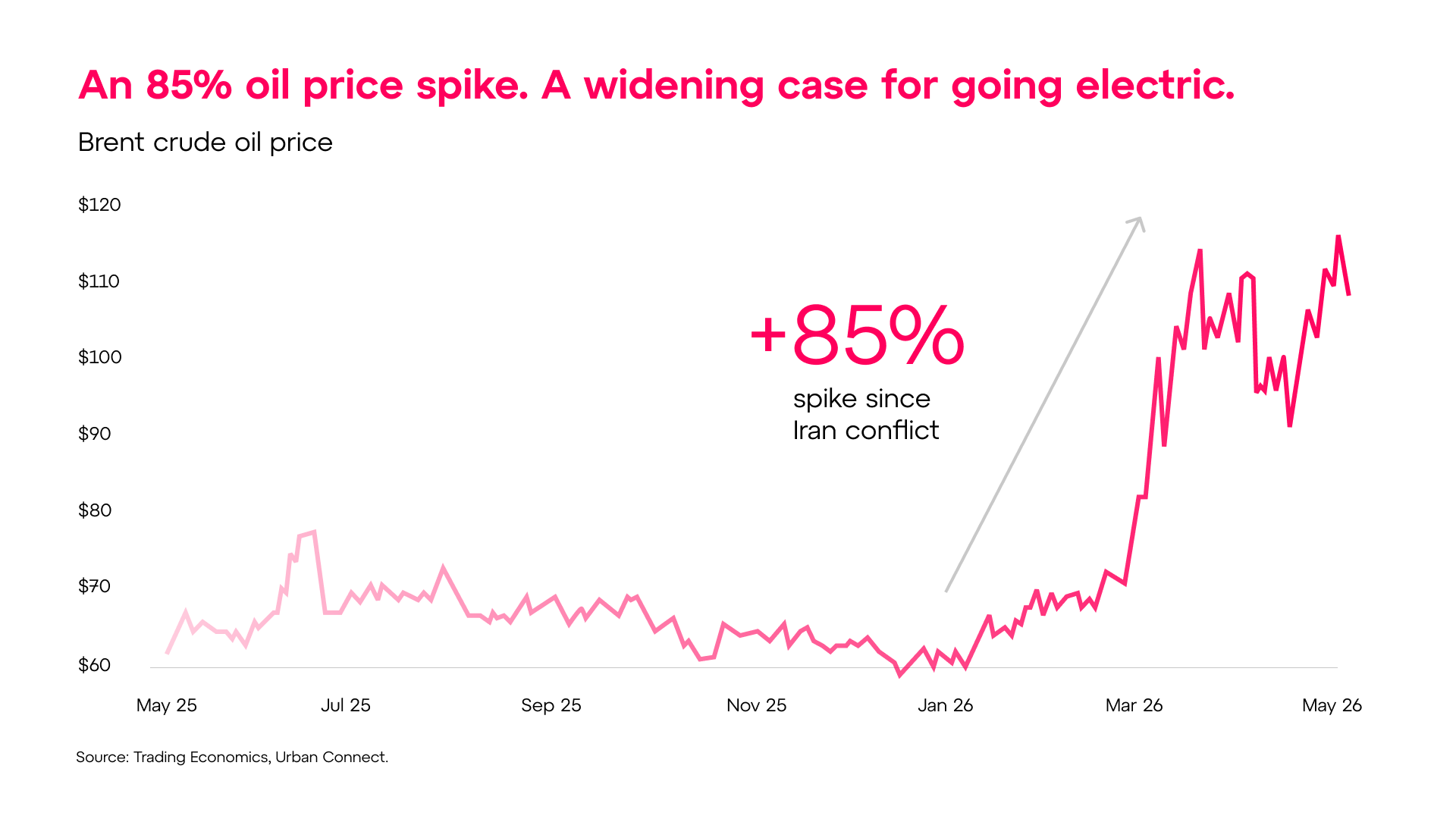
The return of geopolitical risk to oil markets is once again exposing a structural vulnerability in Europe’s economy: dependence on imported fossil fuels. For Switzerland, this is not just a macroeconomic story. It is a direct cost shock to households and companies.
But it also clarifies something that has long been true but insufficiently urgent. Rising oil prices will accelerate the electrification of mobility because electric vehicles (EVs) offer structurally lower and more predictable operating costs.
Three factors underpin this shift: first, EV fuel economics outperform petrol engines, second, lower maintenance cost for EVs, and third, consumers tend to adapt faster to changes in oil prices than anything else.
EV fuel economics outperform petrol engines
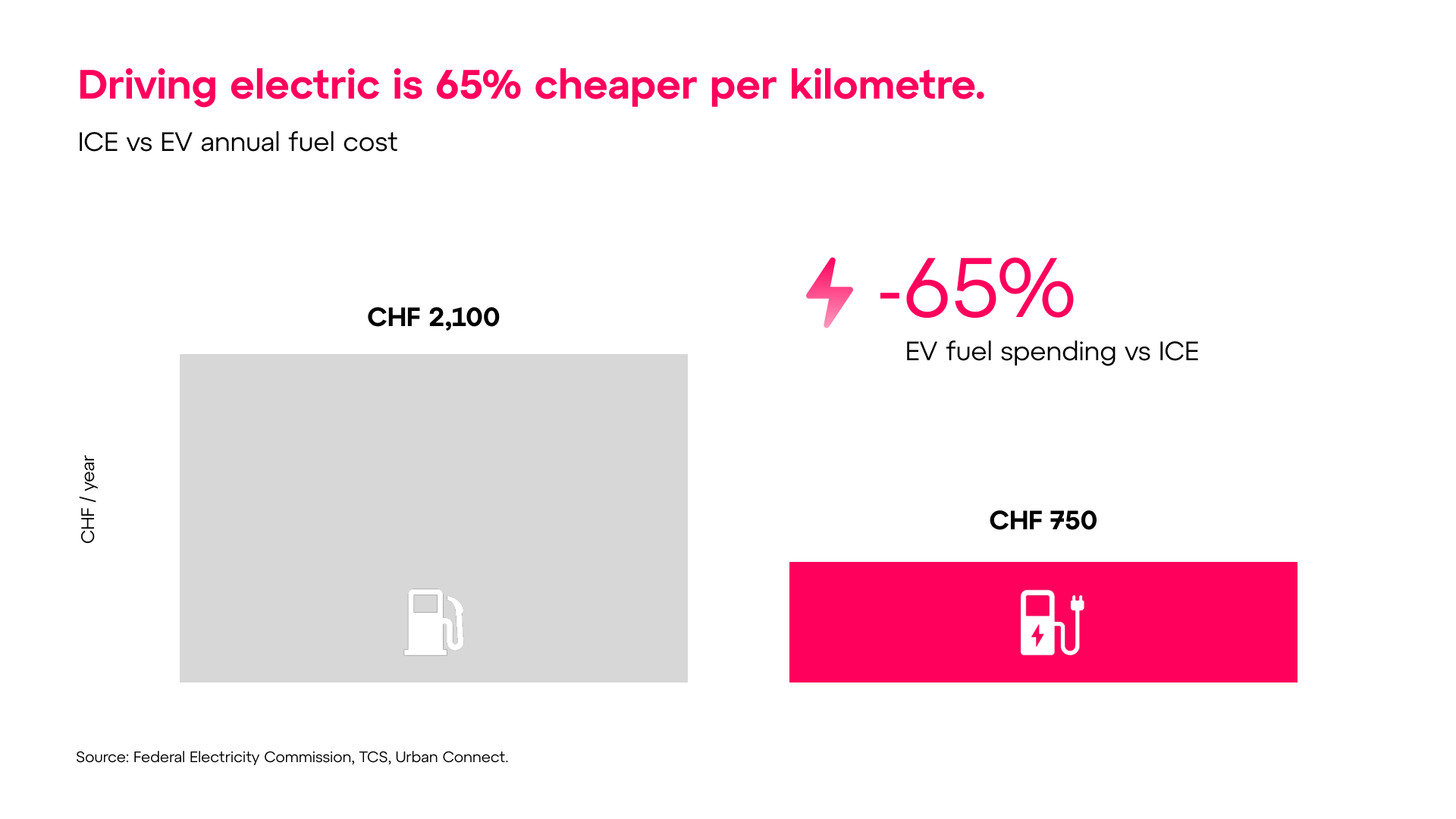
For years, electric mobility has been framed as a climate choice. Increasingly, it is becoming a critical economic cost decision. For example, take a typical Swiss driver covering 15,000 kilometres per year. A petrol-powered vehicle consuming around 7 litres per 100 km, at roughly CHF 2.00 per litre, implies fuel costs of about CHF 14 per 100 km. By contrast, an electric vehicle consuming around 18 kWh per 100 km, charged at home at the 2026 Swiss median rate of approximately CHF 0.28 per kWh (Federal Electricity Commission), costs roughly CHF 5 per 100 km.
The result is stark. Fuel for electric driving is around 65% cheaper per kilometre. On an annual basis, this translates into CHF 2,100 in fuel costs for a petrol car compared to CHF 750 for an EV. This translates into annual fuel savings of nearly CHF 1,300 per vehicle based on current prices.
Maintenance costs for EVs are substantially lower than for petrol cars
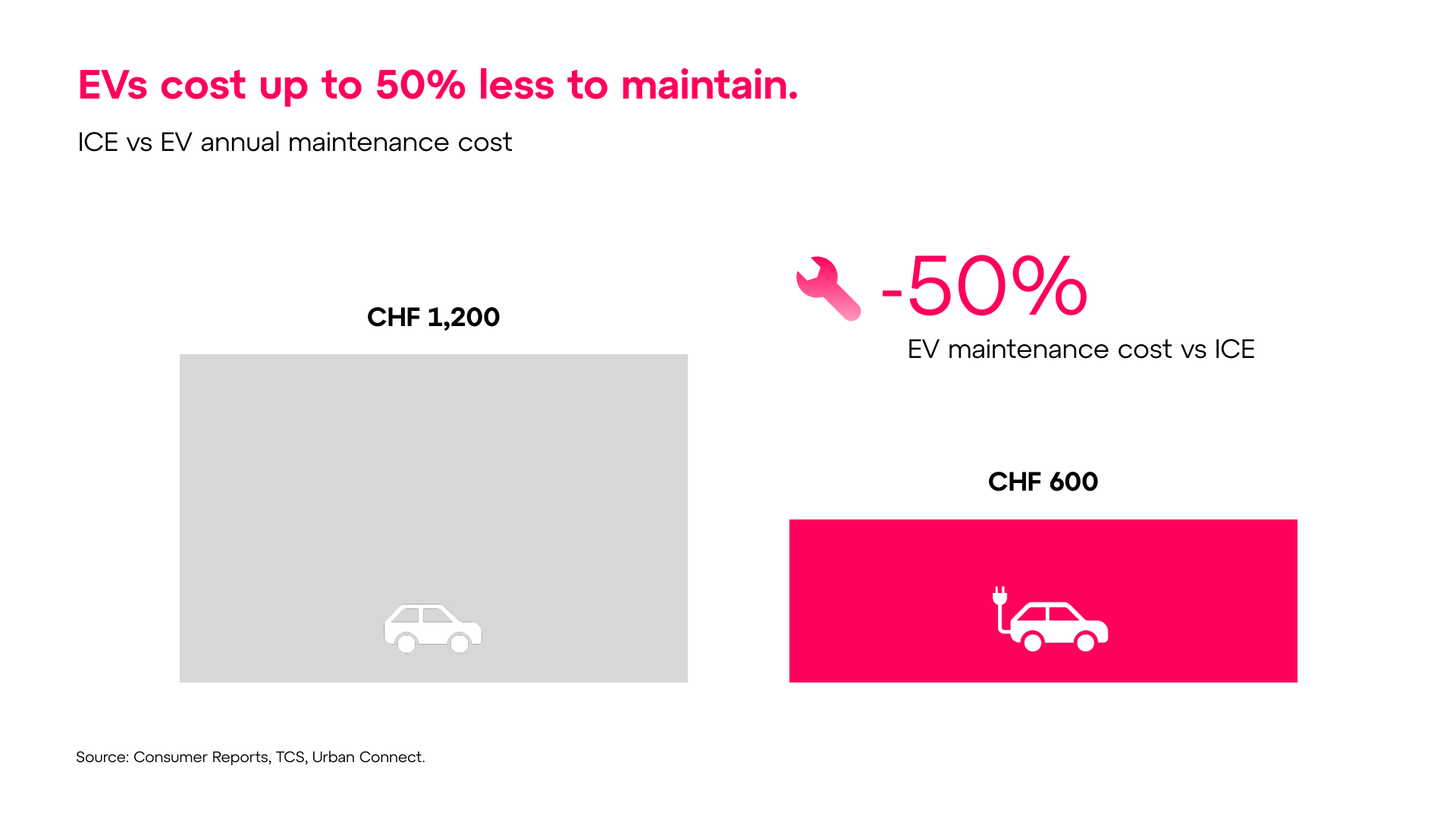
Maintenance reinforces the advantage. The cost gap is rooted in fundamentally simpler engineering. While a conventional petrol car relies on roughly 1,500–2,000 moving parts across engine and transmission, an EV drivetrain operates with a fraction of that complexity. The absence of pistons, valves, multi-gear transmissions and oil systems removes key wear components — and with them, the need for oil changes and frequent servicing.
As a result, maintenance costs are up to 50% lower than for internal combustion vehicles, according to industry-wide estimates. According to the TCS, a typical Swiss car costs around CHF 11,000 per year to operate (based on a list price of CHF 45,000 and 15,000 km annual mileage), with servicing, emissions inspections and repairs alone accounting for roughly CHF 900–1,500 annually at typical Swiss mileage. Applying a 50% EV saving (Consumer Reports) implies approximately CHF 450–750 in maintenance savings per vehicle per year. What was once a marginal benefit is now economically decisive.
Oil shocks do not create the advantage — they amplify it
What changes in a geopolitical crisis is not the existence of this cost gap, but its magnitude and visibility. Evidence suggests that consumers react strongly to fuel price increases. As the Financial Times put it recently, oil prices now “shape the pace more than the direction” of the EV shift: the cost advantage already exists — what fuel price spikes change is how quickly the payback period closes. Every increase in oil prices widens the cost differential and shortens that payback. Every oil price increase raises the financial penalty of staying with combustion.
By contrast, electricity is structurally more stable and increasingly optimisable — through better charging management, dynamic tariffs, and local generation. Electric mobility is not just cheaper than petrol — it is a hedge against energy volatility. The shift is also self-reinforcing. A 2026 Exeter / Nature Communications analysis covered by the Financial Times found that the EV transition has reached a “self-propelling” tipping point in major markets — increasingly independent of subsidies and policy support, and driven instead by underlying economics.
Why corporate fleets could drive the transition
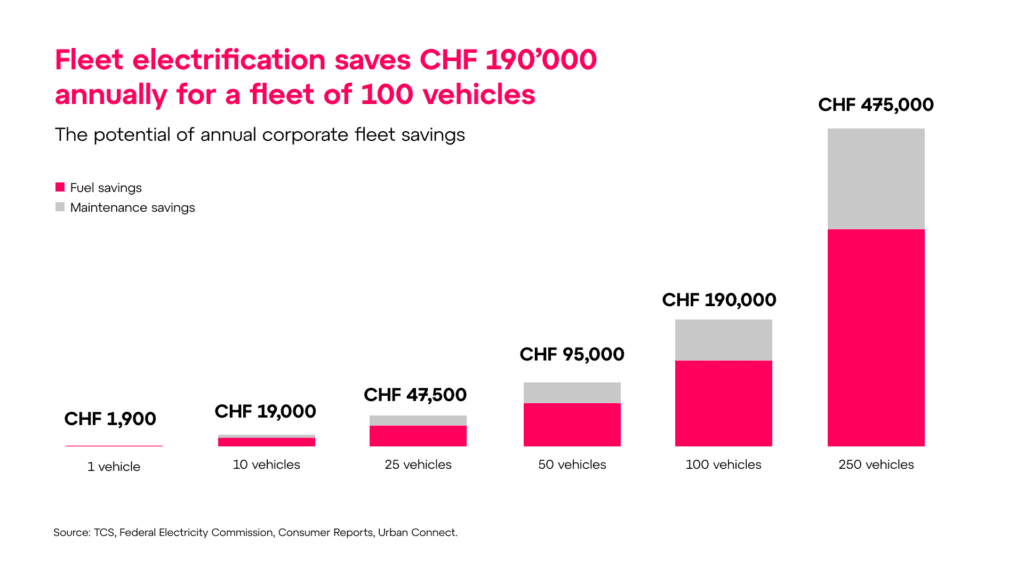
While individual consumers will respond to price signals, the most immediate and measurable impact is likely to be felt in corporate mobility. Consider a fleet of 100 vehicles. Based on the cost differentials outlined above, fuel savings of roughly CHF 1,300 per vehicle, combined with around CHF 600 in reduced maintenance costs, translate into total annual savings of approximately CHF 1,900 per vehicle. Scaled across the fleet of 100 vehicles, this implies a savings potential of around CHF 190,000 per year — a figure that moves electrification firmly from environmental consideration to financial imperative.
And this is only the starting point. Companies benefit from structural advantages that individual consumers cannot fully access:
Cheaper charging at scale: negotiated electricity tariffs, load optimisation, and integration with on-site solar (according to the Swiss Federal Office of Energy)
Higher utilisation: shared fleets reduce the number of vehicles required, especially if they are used for both business and for private purposes.
Operational simplification: centralised and transparent data-driven management and reduced exposure to volatile fuel markets.
Companies are moving beyond simply replacing combustion vehicles with electric ones, and instead redesigning mobility systems altogether — combining shared electric fleets, integrated charging and digital access layers into a single platform. The Urban Connect platform is built for exactly this — combining shared electric fleets, charging integration and a single digital control layer to turn the cost advantage into measurable savings.
In this context, electrification is no longer a sustainability initiative. It is a balance sheet decision.
From cost advantage to default choice
Oil shocks have historically exposed the fragility of existing systems. They rarely create new technologies – but they do accelerate their adoption. The current environment is likely to do the same. In Switzerland, for example, EV adoption is already well advanced, with battery electric vehicles accounting for around 22.7% of new registrations in 2025, according to the Swiss Federal Statistical Office. The wider European trend points the same way: EU EV uptake jumped 49% in March 2026 alone, according to industry data reported by the Financial Times – a direct response to the latest fuel-price shock.
Looking ahead, higher oil and fuel prices only sharpen the already attractive economic proposition of the shift to EVs. Moreover, every kilometer electrified shifts spending from global oil markets to Swiss energy systems. So, the transition is good for the local economy, too. In the medium term, the higher oil prices are likely to mark the moment when electric mobility in Switzerland moves from early adoption to economic default – and when corporate fleets shift from being a necessary expense to becoming a source of economic advantage.