The Right to Charge is coming. Your employees need to charge now.
July 24, 2026
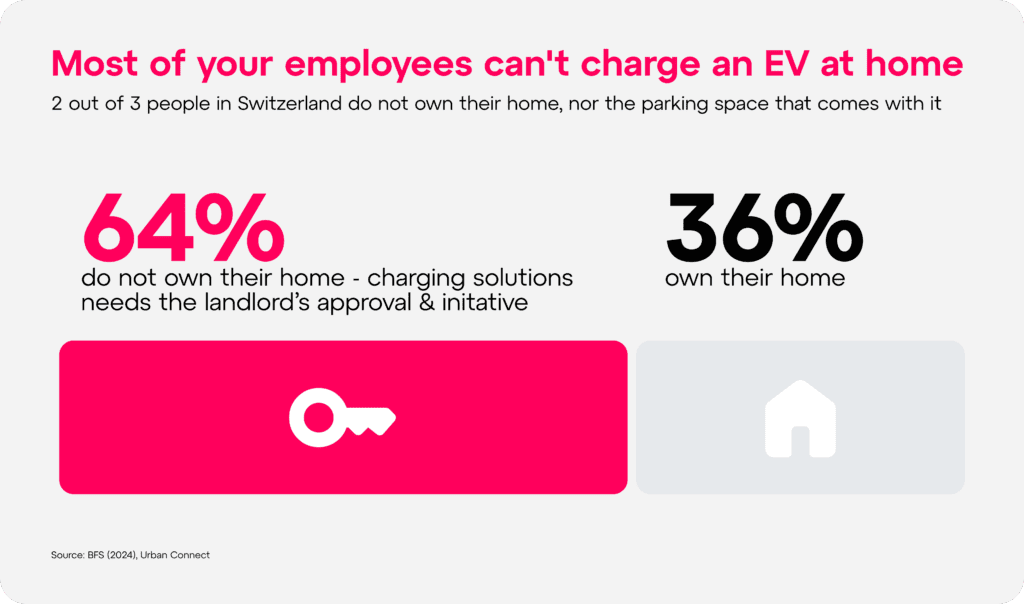
Switzerland is a country of tenants. Only about 36% of households own the home they live in (BFS, 2024). Everyone else parks in a garage they don’t control. This context is now colliding with the electric transition. Nearly every fourth new car registered in Switzerland is fully electric, with the EV proportion growing. Thus, Bern has started writing a “Right to Charge” for tenants into law. Good news, with one catch: even in the best case, the law takes effect in 2027 or 2028, and retrofitting thousands of rental garages will take years beyond that. In that gap, one place can close the charging gap fast: the workplace.
The new law, in short
In June, the Federal Council opened the public consultation on giving tenants and condominium owners a legal right to request EV charging at their parking space. Landlords would have to accept reasonable requests and could pass the installation costs on through the parking rent. Parliament’s reasoning is the interesting part: it identified the lack of home charging as the single biggest barrier to EV adoption in Switzerland, precisely because most people rent. For employers, what the law says matters less than when it takes effect. Not because it creates obligations for them, but because its timeline defines how long employees who rent will have no charging alternative at home. Consultation until October 2026, parliamentary debate after that, entry into force in 2027 at the earliest. Then the retrofitting starts, building by building.
A right to request is NOT a charging cable
The law creates a right to request charging infrastructure, not the infrastructure itself. The market, meanwhile, is not waiting. In the first half of 2026, battery electric vehicles (BEV) reached 23.9% of new registrations, up 20.2% year on year. Together with plug-in hybrids, more than 36% of all new cars in Switzerland now come with a charging plug (auto-schweiz). Every one of those cars needs somewhere to charge, and for the majority of employees who rent, that “somewhere” does not yet exist at home. Even the car industry says so. Announcing the half-year figures, auto-schweiz explicitly called for economically attractive charging at homeand at the workplace. When the industry association names workplace charging as a condition for growth, that is not marketing. It is a market diagnosis.
The workplace is the bridge, and it stays valuable after
A car parked at the office for eight hours is the ideal charging scenario: predictable dwell time, plannable load, daytime charging that can absorb on-site solar production. And unlike the residential rollout, workplace charging depends on no legislation, no landlord consent, no years of consultation. A company that decides to build it can have it running within months or even weeks.
Nor does the Right to Charge make workplace charging obsolete once it arrives. It makes it standard. As home charging spreads, employees will expect charging wherever they park. Companies that build now will operate mature, data-driven infrastructure by the time charging becomes a baseline expectation, and will have banked years of advantage in retention and fleet electrification.
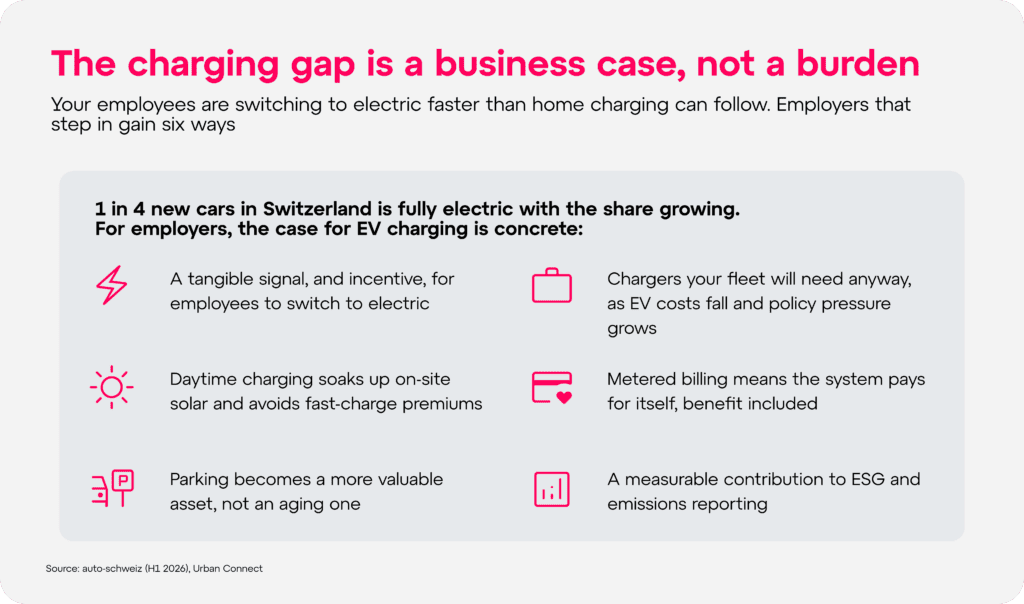
For the company, the case is concrete:
A tangible signal, and incentive, for employees to switch to electric
Chargers your fleet will need anyway, as EV costs fall and policy pressure grows
Daytime charging soaks up on-site solar and avoids fast-charge premiums
Metered billing means the system pays for itself, benefit included
Parking becomes a more valuable asset, not an aging one
A measurable contribution to ESG and emissions reporting
What decision-makers can do now
For CFOs, mobility managers, real estate managers, and HR leaders, the consultation period is not a reason to wait. It is a planning window, and each of these steps has a clear owner in your organisation.
Count your spaces, check your grid. For facility and real estate managers: how many parking spaces, what grid capacity, where does load management pay off? These are the same questions landlords will soon face by law. Employers can answer them today, by choice, often with the electrical infrastructure already in place.
Ask your employees. For HR and mobility managers: who drives electric today, who plans to switch, who can charge at home? In most Swiss companies, the share of employees without home charging access is larger than management expects. A short survey replaces guesswork with a business case.
Make it a fair benefit, not a perk for the few. For HR and finance: metered and billed per session, workplace charging is a benefit every driver can actually use, and employees pay only for what they consume. For an employee who rents, it removes the single biggest obstacle to going electric. That is a retention argument with a number attached.
Plan the operation before the hardware. For fleet and mobility managers: the chargers are the easy part. Access control, billing, load management and reporting decide whether charging works reliably or becomes a support-ticket generator. Load management in particular determines whether you scale with the grid connection you already have, or pay for an upgrade you didn’t need.
From complexity to a single platform
This last point is where most workplace charging projects struggle. Charging stations, parking allocation, user access, billing and fleet vehicles are typically managed in separate systems by separate providers, and every additional software layer is an additional point of failure.
Urban Connect is built to remove exactly this complexity. Our platform connects parking, EV charging operations, fleet vehicles and employee access in one system: an employee books a parking space and operates the charging station within the same platform. The session is metered, billed and reported, without any manual administration from the company side. Direct integration with the charging hardware keeps the infrastructure reliable, and load management lets companies scale charging without expensive grid upgrades. For the employer, charging becomes what it should be: tracked infrastructure without additional admin that simply works.
The Right to Charge will reshape Swiss mobility over the coming decade. But the companies that act now will not be reacting to a law. They will be setting the standard their employees, and the market, are already asking for.
Interested in a workplace parking & charging analysis for your locations?