News
Back
What happens when EV charging finally works?
March 17, 2026
How Urban Connect and Zaptec built a better EV infrastructure
Reliable EV charging is not just about hardware -it’s about how software, infrastructure and mobility services work together. This origin story explains how Urban Connect and Zaptec created a direct integration between mobility platform and charging stations, eliminating unnecessary system layers and making EV charging significantly more reliable for corporate fleets and workplace mobility.
What happens when EV charging finally works?
Most infrastructure innovations don’t begin with a master plan. They begin when something stops working.
In our case, it started in an underground parking garage. Not the most glamorous setting, but then again mostimportant lessons in mobility infrastructure don’t come from conference stages. They happen where infrastructure meets reality: fluorescent-lit garages where something suddenly stops working and someone needs to fix it before Monday morning.
At Urban Connect, we had originally been brought in to integrate our platform with an existing EV charging installation at a corporate facility. The goal seemed straightforward: connect our mobility platform to the charging infrastructure so employees could reserve a parking space and access the charging station assigned to that space. In other words: make charging a seamless part of the workplace mobility experience.
Urban Connect was designed exactly for this purpose. Our platform connects parking, fleet vehicles, EV charging, and mobility services into one unified system, helping companies manage corporate mobility through a single digital interface. What followed, however, turned into a valuable lesson about how fragile EV charging infrastructure can be when too many software layers sit between the charging station and the operator.
When charging infrastructure becomes unreliable
After a few months of operating the location, we discovered that the charging stations were frequentlymalfunctioning. Charging sessions would start but never properly finish. Some chargers became stuck mid-session. Others stopped responding entirely. Sometimes everything worked for a few hours, only to fail again shortly afterwards.
The result became predictable: frustrated drivers, facility managers fielding complaints, and support teams trying to diagnose issues inside systems they did not control.
Many corporate fleet managers and real estate operators are facing similar challenges today. As charging infrastructure grows quickly, the number of software layers between the charger and the operator often grows with it. When something fails, identifying the root cause becomes difficult – and fixing it becomes slow.
When we investigated further, we discovered the core problem: the charging infrastructure was managed through a third-party backend system that neither the operator nor the client actually controlled. So, when something malfunctioned, the operator could only escalate tickets to the vendor and wait. For corporate environments relying on charging for employees and fleet vehicles, that level of dependency creates serious operational risks.
A different approach: own the technology
Urban Connect had originally been hired to integrate systems – not replace them. But as the situation became clearer, so did the solution. The client needed a reliable charging infrastructure, and the existing setup simply could not provide it.
Urban Connect had one key advantage: our mobility platform is built entirely in-house. From the beginning, we believed that managing corporate mobility requires deep control of the technology stack. Instead of stitching together disconnected systems, Urban Connect was built as a unified operating system for workplace mobility.
So we made a decision. Instead of adding yet another software layer on top of the existing system, we would build the charging functionality ourselves and connect directly to the charging stations. That meant integrating session management, access control, billing integration, and reporting directly into the Urban Connect platform.
The objective was simple: remove unnecessary intermediaries and connect the mobility platform directly to the charging infrastructure. For our clients, this approach delivers a very practical advantage: fewer system layers mean fewer points of failure and much higher operational reliability.
Why Zaptec made this possible
Software, of course, cannot operate alone. It needs hardware with which to communicate. In this particular garage, the installed chargers came from Zaptec, the Norwegian manufacturer known for its intelligent EV charging infrastructure.
At the time, we had not yet worked with Zaptec – but we quickly realised we had inherited exactly the hardware we would have chosen ourselves. Zaptec charging stations support open industry standards such as OCPP (Open Charge Point Protocol), allowing platforms like Urban Connect to integrate directly without proprietary barriers.
That openness matters. Zaptec’s system architecture is intentionally designed to work with external platforms rather than replace them. This philosophy aligns perfectly with Urban Connect’s platform approach: hardware and mobility software should cooperate rather than compete.
Zaptec’s chargers also offer dynamic load and energy management, including patented phase-switching technology that allows installations to distribute available electricity intelligently across multiple chargers. For corporate installations and large parking facilities, this is critical. It allows companies to scale EV charging infrastructure without requiring expensive grid upgrades.
Zaptec also provides cloud-based monitoring through the Zaptec Portal, enabling remote maintenance, system diagnostics, and over-the-air software updates. The result is a charging infrastructure that remains stable and secure over time. In practice, Zaptec delivers the intelligent charging hardware, while Urban Connect provides the software platform that orchestrates how that infrastructure is used within a company’s mobility ecosystem.
Direct integration: how the system works
Once we began integrating the Urban Connect platform directly with the Zaptec charging infrastructure, things improved quickly. Charging sessions began completing reliably. Access control worked as intended, and reporting and billing ran smoothly.
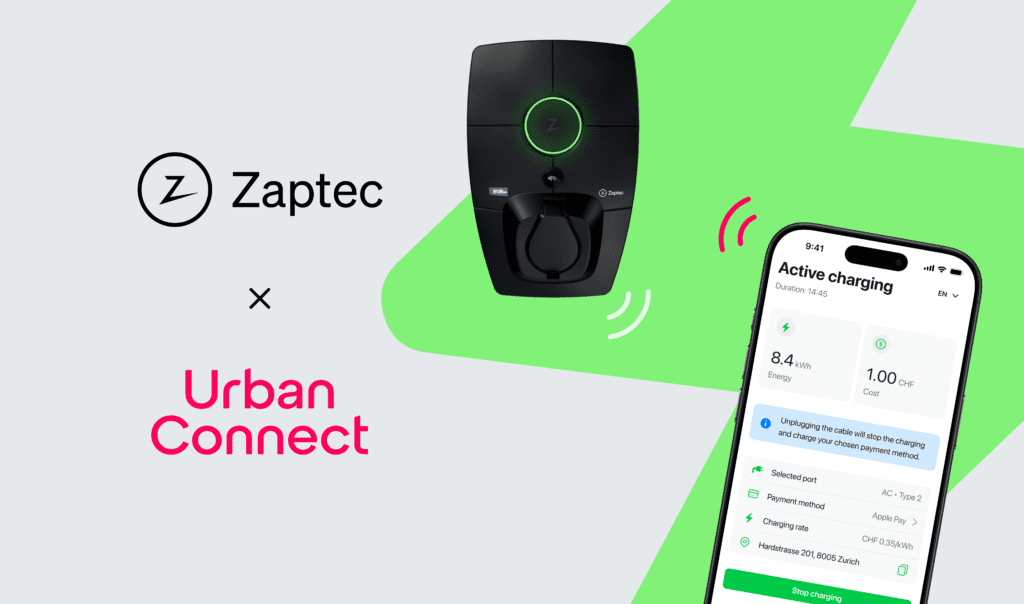
For example, when an employee books a parking space equipped with a Zaptec charger through the Urban Connect platform, the system automatically grants access to the charger, starts the charging session when the vehicle connects, and records the session for reporting and billing. For facility managers and fleet operators, this removes manual administration and ensures the charging infrastructure simply works in the background.
So, Urban Connect effectively acts as the digital control layer for corporate mobility infrastructure, integrating parking, fleet vehicles, EV charging and user access into one coherent system.
“The fewer software layers between the mobility platform and the charging station, the more reliable the infrastructure becomes.” – Sergey Tsvetkov, CTO Urban Connect
From broken system to reliable infrastructure
What had been a constant support issue quickly became invisible infrastructure – the kind facility managers no longer need to think about. Today, this architecture allows Urban Connect clients to manage parking, EV charging access, fleet charging, and user management within a single integrated mobility platform, while Zaptec provides the intelligent charging hardware.
For companies electrifying their fleets or offering charging to employees, this model provides several advantages:
Urban Connect was designed to make workplace mobility infrastructure easier to operate – and integrating directly with Zaptec charging infrastructure is a natural extension of that philosophy.
Hardware and software aligned to power the future of corporate mobility
What quickly became clear during this project was that Zaptec and Urban Connect approach the mobility ecosystem in a very similar way. Zaptec focuses on building intelligent, reliable charging infrastructure designed for large-scale deployments, while Urban Connect focuses on orchestrating mobility services through software. Together, this creates a powerful combination: best-in-class charging hardware combined with a mobility platform that integrates charging seamlessly into corporate mobility operations.